
Black Friday 2026 falls on Friday 27 November. Payday lands two days earlier, on Wednesday 25 November. Cyber Monday follows on the 30th.
That gives South African marketers one tight window where every inbox, phone and WhatsApp chat fills up at once.
Most brands treat that window like a fire hose. They blast every contact they own, on every channel, three times a day. Then they spend December wondering why their emails land in spam and their WhatsApp number got throttled.
Here's the thing. Mailbox providers and Meta don't care that it's Black Friday. They judge you on the same rules in November as in March. The only difference is that you break more of them, faster.
This year adds a new twist. The NCC Opt-Out Registry moved to full enforcement on 1 October 2026. Black Friday is the first big peak where sending to the wrong person can cost you up to R1 million.
This guide gives you a send plan that keeps your offers in front of buyers and your sender reputation intact. It covers:
- Why reputation breaks during peak season
- Which channel to use for which job
- An eight-week countdown, starting now
- Channel-specific rules for email, SMS and WhatsApp
- South African compliance you can't skip
- What to watch on the day, and how to recover after
Why sender reputation tanks on Black Friday
Sender reputation is a trust score. Gmail, Outlook, Yahoo, mobile networks and Meta each keep one on you. They build it from how people react to your messages.
Opens, clicks, replies and reads push it up. Bounces, spam complaints, blocks and ignored messages drag it down.
Black Friday hits that score from five directions at once:
- Volume spikes. You jump from 50,000 sends a week to 500,000 in three days. Filters read a sudden spike as a spammer warming up.
- Cold contacts come back. Someone digs up the list of people who haven't opened since 2023. Those addresses bounce, sit unread or hit the spam button.
- Everyone sends at once. Inboxes get crowded, so engagement per message drops. Lower engagement means lower reputation, even for good senders.
- Frequency creep. One email becomes three a day. Subscribers who would have ignored one message now report all three.
- Rushed builds. Broken links, missing unsubscribe links and image-only emails slip through when the team works at 23:00.
The rules haven't gone soft either. Since 2024, Gmail and Yahoo require anyone sending around 5,000 or more emails a day to their users to:
- Authenticate with SPF and DKIM, and publish a DMARC record
- Align that authentication with the domain in your From address
- Add one-click unsubscribe and honour opt-outs within two days
- Keep spam complaints below 0.3%, and ideally under 0.1%
Microsoft brought in similar authentication rules for Outlook.com addresses in May 2025.
A 0.3% complaint rate means three complaints per 1,000 emails. On a 200,000-person Black Friday blast, 600 annoyed people can push you over the line.
The damage also lasts. Reputation drops in a day and takes weeks to rebuild. Torch it on 27 November and your festive season campaigns land in spam too.
Which channel for which job
Email carries the story, SMS carries the urgency, and WhatsApp carries the conversation. Give each channel one job and you halve the number of messages you need to send.
| SMS | |||
|---|---|---|---|
| Best job | Teasers, full catalogue, gift guides, order confirmations | Doors-open alerts, flash deals, last-chance reminders | VIP early access, product questions, order updates, abandoned carts |
| Content | Rich: images, many products, long copy | 160 characters and one link | Rich media, buttons, two-way chat |
| Cost per message | Lowest | Medium | Highest, charged per template delivered |
| Who to send to | Your full opted-in, engaged list | Your best buyers and opted-in mobile numbers | Customers who opted in to WhatsApp and engage |
| Safe frequency on the day | 1 to 2 sends | 1 send | 1 template, then reply freely inside the 24-hour window |
| Biggest reputation risk | Spam complaints and bounces from old contacts | Opt-outs and sending outside legal hours | Blocks and reports that lower your quality rating |
A simple way to split the work:
- Email builds desire. Use it in the weeks before to tease deals, collect wish lists and get people to sign up for early access.
- WhatsApp rewards loyalty. Give your best customers the first look, then answer their questions in the same chat.
- SMS creates the moment. Save it for "Doors are open" and "Six hours left". Two well-timed texts beat five forgettable ones.
Don't send the same offer on all three channels to the same person at the same time. That's not omnichannel. That's nagging. Pick a lead channel per segment and use the others as backup for people who didn't engage.
The eight-week countdown
Reputation gets built in October and spent in November. If you start the week before Black Friday, you're already late.
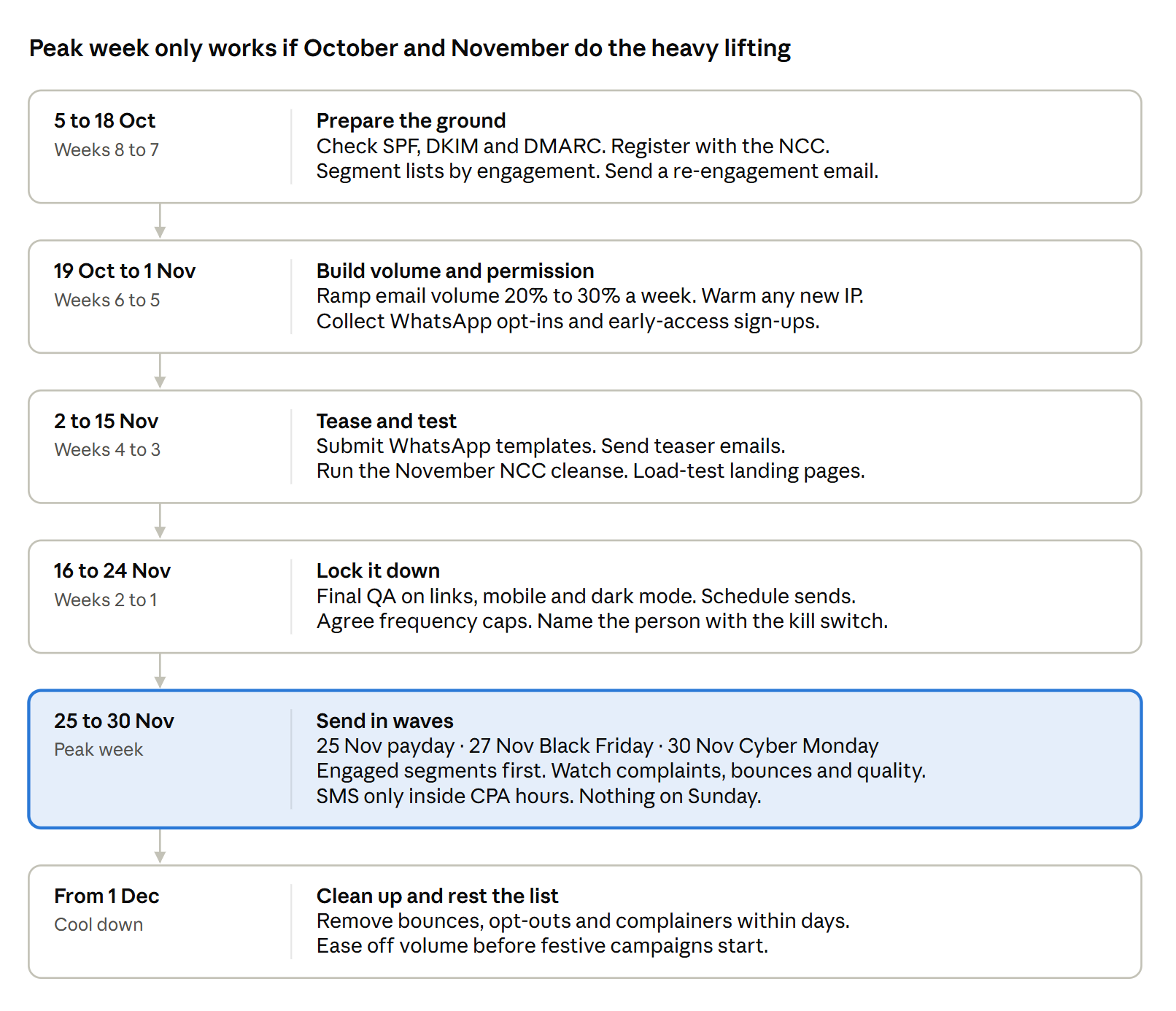
Each phase depends on the one before it. You can't safely ramp volume in late October without clean, segmented lists, and you can't send in waves on the day without approved templates and a tested schedule.
Email: send more without landing in spam
Email can take the biggest volume, so it can also do the biggest damage. Get these right before you touch a template.
1. Lock down authentication
- Check that SPF, DKIM and DMARC exist for the domain you send from, and that they align with your From address.
- Start DMARC at p=none if you haven't got one yet. It still meets the Gmail and Yahoo rule.
- Don't switch to a new sending domain or subdomain in November. A fresh domain has no history, and filters don't trust strangers at peak.
2. Ramp up volume, don't jump
- Increase sends gradually from mid-October. Add 20% to 30% more volume each week rather than tripling it on the day.
- If you plan to send on a new dedicated IP, start warming it now. Six weeks is the minimum.
- Spread big sends over a few hours instead of releasing a million emails at 06:00 sharp.
3. Send to people who want it
- Split your list by engagement. People who opened or clicked in the last 90 days get the full Black Friday programme.
- People who engaged 90 to 180 days ago get one or two of your best emails.
- Anyone silent for longer than six months gets left out, or gets one re-engagement email in October. Only the ones who respond join the Black Friday list.
- Remove hard bounces after every send.
4. Set a frequency cap and stick to it
- Plan two to three emails in Black Friday week for most segments: a teaser, doors open and last chance.
- Let subscribers choose. A "Send me fewer emails until December" link keeps people who would otherwise unsubscribe or report you.
- Suppress anyone who already bought from the "last chance" send.
5. Build emails that email filters like
- Keep a healthy balance of text and images. One giant image with no live text looks like spam.
- Write subject lines that tell the truth. "Your order is waiting" for a promo email earns complaints.
- Put the unsubscribe link where people can find it. Hiding it doesn't stop unsubscribes. It turns them into spam reports.
- Test every link and preview on mobile, in dark mode and in Gmail's Promotions tab before you schedule.
6. Separate transactional from marketing
Order confirmations, delivery updates and password resets must arrive, even if your promo emails struggle. Send them from a separate subdomain or stream, so a promo complaint spike doesn't slow down someone's receipt.
SMS: short, sharp and on time
SMS lands on the lock screen, so it gets read. That's its power and its risk. A badly timed text annoys people faster than any email.
Respect legal sending hours
The Consumer Protection Act limits when you may contact consumers for direct marketing:
- Monday to Friday: 08:00 to 20:00
- Saturday: 09:00 to 13:00
- Sundays and public holidays: no direct marketing
Black Friday falls on a Friday, so you have a 12-hour window. The weekend that follows is tighter. A "Weekend deals end tonight" SMS at 18:00 on Saturday breaks the rules. So does a Sunday reminder.
Schedule in South African time (SAST) and double-check any platform that defaults to UTC.
Keep it lean
- Stay within 160 characters. Emojis and some special characters switch the message to Unicode, which cuts the limit to 70 characters and can double your cost.
- Lead with the offer and the deadline: "40% off all sneakers until midnight."
- Name your brand in the first few words, so nobody wonders who's texting them.
- Include a free opt-out, such as "Reply STOP to opt out", in every marketing SMS.
Watch your links
- Use a branded short link (for example, yourbrand.co.za/bf) instead of a free public shortener. Networks and phones flag generic short links as possible scams.
- Make sure the landing page loads fast on mobile data and can handle the traffic. An SMS that sends 50,000 people to a crashed site wastes the click and burns trust.
Send less, to the right people
- Use SMS for your best customers and for moments that need urgency: doors open, back in stock, last six hours.
- Cap it at one to two marketing texts across the whole Black Friday weekend.
- Remove opt-outs immediately and clean out numbers that fail to deliver.
WhatsApp: the VIP lounge, not the loudhailer
WhatsApp gets attention like nothing else, which is exactly why Meta polices it so closely. Treat it as your premium channel for customers who asked to hear from you there.
Get templates approved early
- Every business-initiated message needs a pre-approved template. Submit your Black Friday templates by early November, not the night before.
- Write a few versions of each. If Meta rejects one, you have a backup ready.
- Use buttons such as "Shop now", "Remind me later" and "Stop promotions". They make it easy to say yes, and easy to leave without hitting Block.
Guard your quality rating
- Meta rates your number based on how people respond, especially blocks and reports.
- A low rating can pause templates and cap how many people you can reach in 24 hours.
- Your messaging limit sets how many unique customers you can message in a rolling 24 hours. If your audience is bigger than your current limit, start sending good-quality campaigns in October so your limit grows before peak.
Expect Meta to cap you
- Meta limits how many marketing templates each person receives, based on how often they read marketing messages and how full their inbox is.
- If a message hits that cap, it fails with error code 131049. Meta advises waiting at least 24 hours before trying that person again. Retry too soon, and you can trigger a 24-hour block.
- On Black Friday, every brand fights for the same caps. That's another reason to send one strong template instead of three average ones.
Know what you pay for
- Meta charges per marketing template delivered.
- When a customer replies, a 24-hour customer service window opens. Your replies inside that window are free and don't count towards the per-user marketing cap.
- Design for replies. "Want first access to the deals at 06:00? Reply YES" turns one paid template into a free conversation.
- Click-to-WhatsApp ads open a 72-hour free window, which works well for Black Friday lead-gen.
Only message people who opted in to WhatsApp
An email opt-in doesn't give you WhatsApp permission. Collect it separately, say what you'll send and how often, and keep a record of when and where each person agreed.
South African compliance you can't skip this year
Black Friday 2026 is the first major sales peak under full NCC Opt-Out Registry enforcement. A big list with no compliance checks used to be risky. Now it's expensive.
NCC Opt-Out Registry
- Enforcement started on 1 October 2026. Consumers can block direct marketing across email, SMS and calls, by brand, industry or channel.
- A block on the registry overrides any opt-in consent you collected before.
- You must register as a direct marketer and clean your database against the registry every month before you send. Cleansing costs R0.12 per record the registry removes or restricts.
- Penalties go up to R1 million or 10% of annual turnover, whichever is greater.
Book your November cleanse early. If you send on 27 November using a list you cleaned in October, check whether it still counts as current.
POPIA
- Only market to people who gave consent, or to existing customers who bought something similar and can opt out of every message.
- Make opting out free and easy on every channel.
- Don't buy or rent lists to boost Black Friday reach. Bought lists break POPIA and wreck your reputation at the same time.
On the day: watch the dials, not just the sales
Sales numbers tell you how Black Friday went. Delivery numbers tell you whether December will work too. Put someone in charge of both.
Set your warning lines before you send
| Metric | Healthy | Pause and investigate |
|---|---|---|
| Email spam complaints | Under 0.1% | Over 0.3% |
| Email hard bounces | Under 1% | Over 2% |
| Email unsubscribes | Under 0.5% | Over 1% |
| SMS delivery failures | Under 3% | Over 5% |
| SMS opt-outs | Under 0.5% | Over 1% |
| WhatsApp quality rating | High (green) | Drops to medium (yellow) or low (red) |
These are working benchmarks, not universal laws. Compare them against your own normal results from the last three months.
Send in waves
- Send to your most engaged segment first. If their results look healthy after an hour, release the next segment.
- If the first wave goes wrong, you've hurt 10% of your list, not all of it.
Have a kill switch
- Know who can pause a campaign, and make sure they're online on the day.
- If complaints spike, stop the send, fix the cause and resume with a smaller, more engaged segment.
- Keep Google Postmaster Tools and your platform's reporting open, and check your WhatsApp quality rating every few hours.
Answer people
Black Friday WhatsApp replies come in fast. Staff the inbox or set up automated answers for delivery times, returns and stock questions. A customer who gets an answer buys. A customer who gets ignored blocks.
After the rush: cool down before the festive season
Black Friday ends on 27 November, but your busiest stretch doesn't. Cyber Monday, festive gifting and January sales all depend on the reputation you protected this week.
- Cyber Monday (30 November). Send only to people who engaged during Black Friday week but didn't buy. Skip anyone who ignored everything.
- Drop the volume in early December. Give subscribers a breather before festive campaigns start. A short gap lowers complaints later.
- Clean up your list. Remove hard bounces, failed numbers, opt-outs and anyone who complained. Do it within days, not in January.
- Thank your buyers. A delivery update or a simple thank-you on WhatsApp or email gets replies and positive engagement. Mailbox providers and Meta notice both.
- Review the numbers. Note which segments, channels and send times worked, and which caused complaints. That's your plan for 2027.
Make Black Friday your best send, not your last good one
The brands that win Black Friday don't send the most messages. They send the right message, on the right channel, to people who want it.
TouchBasePro puts email, SMS and WhatsApp under one roof, with deliverability support from a South African team that has seen plenty of Black Fridays. Want a second pair of eyes on your peak-season plan? Talk to us before your first teaser goes out.